Three Part Cards for Calm, Independent Learning
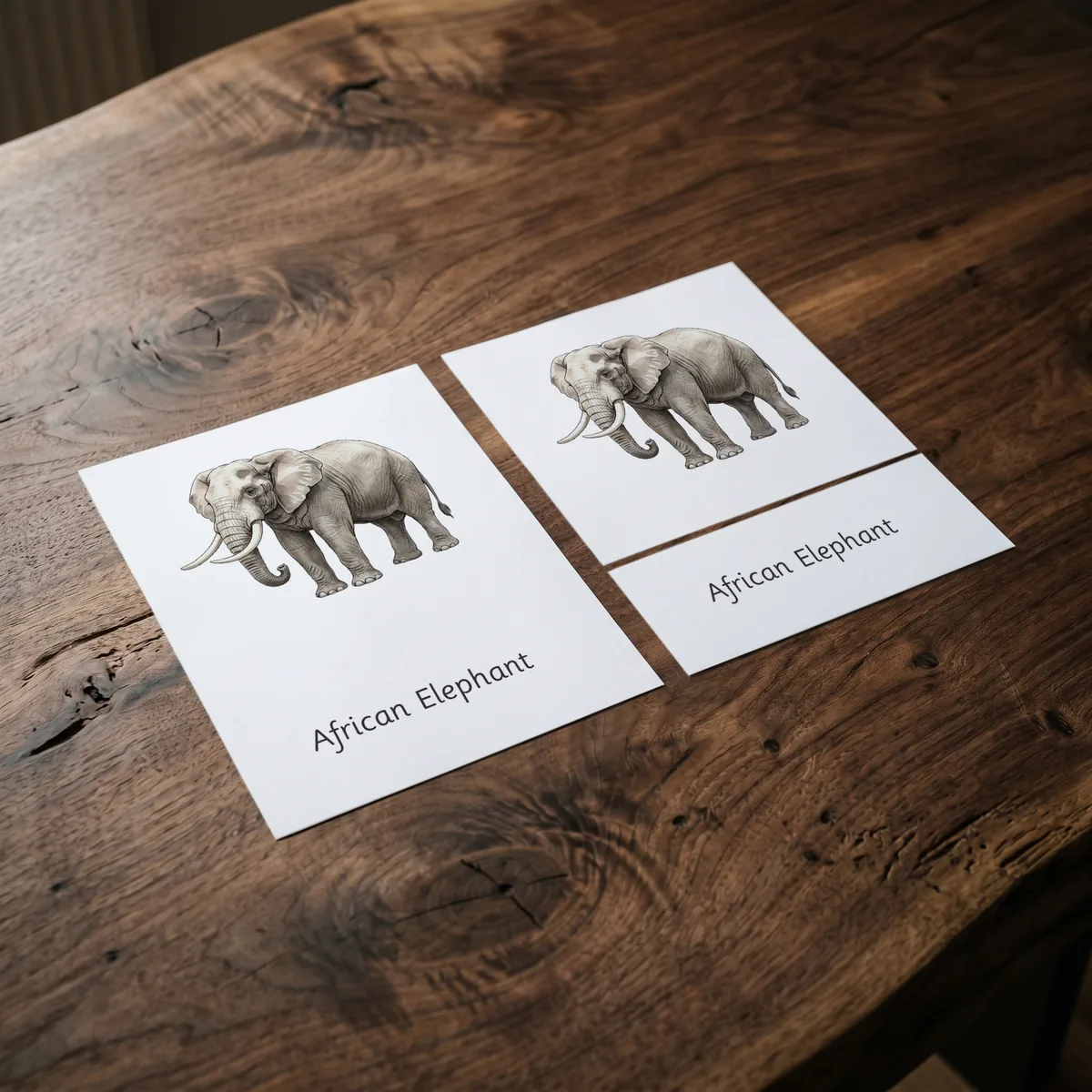
Three part cards are simple learning cards with three parts: a picture card, a word card and a control card that shows the picture and word together. They help children connect real objects, spoken language and written words in a calm, independent way.
At first, they look like a simple matching activity. But the real value is deeper. Children learn to name, compare, read, notice and correct their own work.
What are three part cards?
Picture card
The picture card gives the child something concrete to look at. It is the starting point — a real image to name, examine and remember.
Word card
The word card introduces the written form of the name. The child places it next to the matching picture.
Control card
The control card combines both the picture and the word. The child uses it to check their own match without asking an adult.
What are three part cards used for?
Three part cards support vocabulary and early reading in a direct, hands-on way. A child builds a small collection of words they can see, say aloud and match to a picture — one at a time, at their own pace.
Beyond the basic match, the cards support concentration, sorting by category or colour, and independent correction. Children can also use them for spoken work — naming each picture, describing it, comparing two cards side by side. The same set of cards can be used in many different ways as the child grows.
Three part cards are used in Montessori inspired learning spaces, at home and in small group lessons. They work well for vocabulary, early reading, matching activities, sorting and speaking about a topic.
Why they work well for children
When a child uses three part cards, they are not only memorising a word. They connect a picture, a spoken name and a written label at the same time. This makes reading more concrete — the written word is not abstract; it belongs to something real.
The control card makes a real difference. Because the child can check their own work, the adult does not need to correct every step. The child can try, compare and correct alone. This builds confidence and keeps the focus on the work itself, rather than on getting it right for someone else.
How children use the cards
The child looks at the picture cards and names what they see.
The child matches the word cards to the pictures.
The child checks the work with the control cards.
Later, the cards can be used for sorting, speaking and small research questions.
More than a matching activity
Three part cards can invite real conversation. Children compare size, colour, habitat, category or personal preference. A small set of cards becomes a starting point for questions like:
Which one is bigger?
Where does it live?
Have we seen this before?
Which card do you like most?
These questions come naturally when the cards show something real. Children notice detail when the illustrations are accurate — and accurate illustrations are what make the conversation worthwhile.
Who are these cards for?
Three part cards often work well for children aged three to six, though every child moves at their own pace. They are a good fit for children who are beginning to connect pictures and words, who enjoy calm, visual work and who like to move things with their hands.
Families learning at home, Montessori inspired learning spaces, small group lessons and preschool settings all use three part cards regularly. They are simple to set up, reusable and easy to adapt as the child grows.
If you are looking for printable three part cards that support independent learning at home, this set was made with that in mind. See how we approach the illustrations.
What is included
- Picture cards, one per animal
- Word cards
- Control cards
- Printable PDF format
- A4 and US Letter sizes
- Clear layout for cutting
- Calm visual style, no distracting decoration
Questions about three part cards
Three part cards are a set of learning cards with three pieces: a picture card, a word card and a control card. The picture and word cards are matched by the child. The control card shows both together so the child can check their own work.
The control card lets the child check whether they placed the word card next to the right picture. It gives the child independence — they do not need to ask an adult every time they want to know if they are right.
Three part cards are widely used in Montessori inspired learning and fit naturally with the principle of independent, hands-on work. The format — picture, word, control — follows the same logic found in classical Montessori nomenclature cards.
Yes. Three part cards work well at home and do not require a classroom or special equipment. A clear table and a small set of cards is all that is needed.
No. A child can begin by naming and matching the picture cards before the written words become important. The word cards can be introduced gradually as the child is ready.
Vocabulary, early reading, concentration, sorting, comparison and independent correction. The cards also support spoken language and can become a starting point for small conversations or research questions.
Start with one small set, one quiet table and a few real words your child can see, say and understand.