Flashcards for Quick Recall and Confident Naming
Flashcards are simple cards, each with one clear image and its printed name. A child looks, says the name and moves on — quick, repeatable practice that turns a name they half-know into one they can say without hesitation.
Built for one job: fast recall. Not where a child first meets a name, but how they keep it sharp once they do.
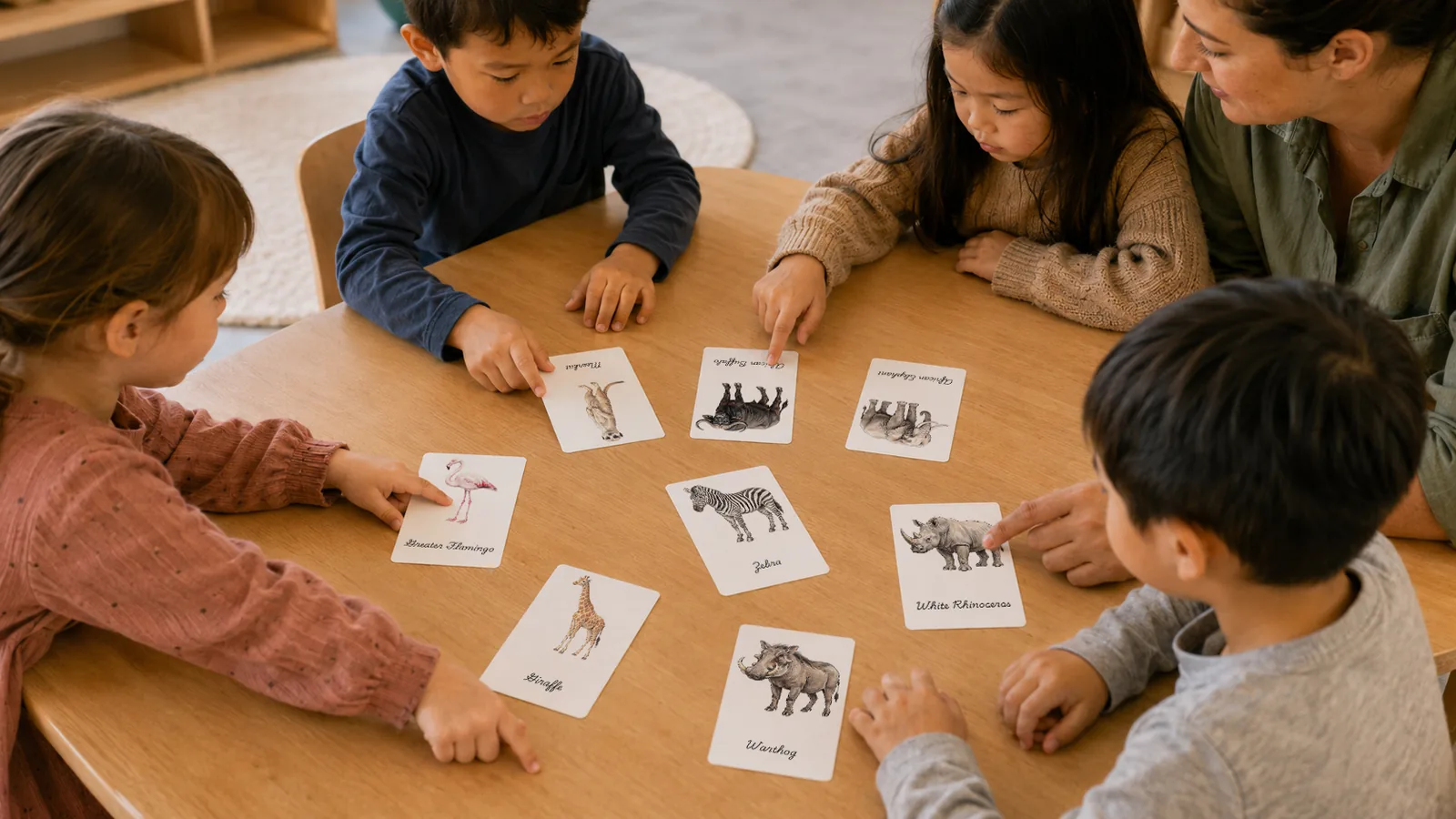
What are flashcards?
One image
A single, clear subject with no clutter, so recognition is immediate. The eyes land on the picture and the name follows.
One name
The printed word beneath the image ties the spoken name to its written form, so reading the card reinforces the letters too.
One quick answer
The child names it and moves on — no matching, sorting or setup. That simplicity is what makes flashcards fast.
What are flashcards for?
Flashcards are made for recall, not for first teaching. They work best once a child already knows a handful of names and wants to get faster and surer at producing them. Flipping through a small stack, naming each card, is quick practice that fits into a few spare minutes.
They are a review-and-speed tool. The goal is not to introduce a word, but to keep an already-met word sharp — building naming speed, vocabulary and the quiet confidence that comes from knowing an answer cold.
Flashcards are used at home, in classrooms and in small group lessons, wherever a child is ready to build speed and vocabulary from names they have already met.
Why flashcards work
There is a well-studied reason this kind of practice works. The act of trying to remember something — actually retrieving a name from memory rather than re-reading it — strengthens that memory far more than passive review does. Researchers call this the testing effect, or retrieval practice.
Flashcards are retrieval practice in its simplest form. Each card is a tiny test: can the child produce the name? Spreading those tests across several short sessions, rather than one long one, strengthens memory further still — an effect known as spaced repetition. When naming a card stays calm and low-pressure, children keep trying, and it is the trying that does the work.
How to use flashcards well
Start with a small stack of names the child has already met — five to ten cards, not the whole set.
Show one card. The child says the name, then you turn to the next. Keep the pace light and quick.
Go through the stack once. A single pass of a few minutes is plenty for one sitting.
Set aside the cards the child names easily, and keep the ones they miss.
Come back to the harder cards more often, across several short sessions, until they too become easy.
Flashcards vs. three part cards
Flashcards and three part cards are often confused, but they do different jobs. A flashcard pairs an image with its printed name on a single card, built for fast recall. Three part cards split that into a picture card, a word card and a control card, so the child matches the pieces and checks their own work.
Meeting a name for the first time? Reach for three part cards.
Keeping a known name quick and sure? Flashcards.
Use three part cards to teach a name and let the child self-correct; use flashcards to review it until it comes instantly. They are two steps of the same path, not rivals.
Who are flashcards for?
Flashcards suit children who are ready to build speed and vocabulary — usually those who already recognise a few of the names and want to get quicker. They ask nothing of the adult beyond turning cards and listening.
Families learning at home, classrooms, small group lessons and preschool settings all use flashcards for quick daily practice. They are simple to set up, reusable and easy to reprint as a child grows into new sets.
If you want printable flashcards with clear, honest illustrations, our sets were drawn with that in mind. See how we draw our cards.
What is included
- Picture-and-name cards, one per subject
- Three label styles: Basic Manuscript, American Cursive, Printed Letters
- Printable PDF format
- A4 and US Letter sizes
- Clear layout for cutting
- Calm visual style, no distracting decoration
Questions about flashcards
Flashcards are used for quick recall and naming practice. A child sees one image, says its name, and moves on, building speed and confidence with vocabulary they have already been introduced to, rather than learning a name for the first time.
Flashcards work best once a child already knows a few of the names in the set. They are a review-and-speed tool, most useful after the names have first been introduced through slower, hands-on matching work.
A flashcard pairs an image with its printed name on a single card for fast recall. Three part cards separate the picture, the word, and a combined control card, so the child matches them and checks their own work — a slower activity better suited to first introducing a name.
Naming a card makes the child retrieve the answer from memory, and this act of retrieval strengthens memory far more than re-reading does. Spreading short flashcard sessions over several days strengthens recall further through spaced repetition.
Short. A few minutes with a small stack is more effective than a long drill. Set aside the cards a child names easily and revisit the harder ones more often, keeping the practice low-pressure and repeatable.
Each set is an instant digital download that prints at home in A4 or US Letter. Labels are available in Basic Manuscript, American Cursive and Printed Letters, so the written name can match the script a child is currently learning.
A small stack, a few quiet minutes, one image at a time — that is all it takes to make a known name quick and sure.